Student No. 868447
How much mythology is portrayed on carvings in ancient Greece?
From my initial research I thought that the depiction of mythology only appeared on temples and treasuries. I also thought that there was quite a large amount of carvings that depicted mythology. However my views on both these points have changed since going on the study tour to Greece. The Greeks did not limit themselves to carve mythology only on temples and treasuries but included them in anything that could be carved. The visual representation of mythology appears on many different types of architecture from temples to gravestones. By looking at the many varied types of architecture mythology appears upon it is clear to see just how much mythology is actually portrayed through stone carvings. In my first essay I described the mythology which appeared upon the temple of Zeus, the Parthenon and the treasury of the Athenians at Delphi. From travelling around Greece I discovered more portrayals of Greek mythology in stone from each of these three sites and other sites that I visited.
The best evidence for mythology appearing on a range of different buildings was not from looking at the different sites but at the museums. The museum with the most evidence was the new Parthenon museum in Athens. There were many buildings which depicted scenes from mythology ranging from temples to treasuries with some buildings unidentified. Most of the buildings in the Parthenon museum were found on the Parthenon. One of these buildings which archaeologists believe to be a treasury depicts two unusual mythological events. Both pediments show Herakles. One depicts Herakles in his usual heroic role, fighting Hydra, whilst the other shows Herakles being introduced to Hera for the first time. Another building was the Archaios Naos, or Old Temple, which was destroyed by the Persians in 480/79BC also depicted mythology. The pediment shows the popular myth of gods versus giants with Athene felling the giant Engelados at its centre. Little remains of the other pediment with the only surviving parts depicting a lion attacking a bull. This does not seem mythological but as there is not enough left to see most of the other subjects it cannot be used as evidence for non mythological depictions in stone. There were many other archaeological remains of stone buildings in the Parthenon museum with most depicting some sort of mythological story or event on them. Visiting the Parthenon museum has helped change my view on mythological portrayal on buildings. Firstly it shows that there is a massive amount of mythological portrayal in stone carvings which is more than I expected to see, especially on such a small site as the Acropolis. Secondly, it shows that the Greeks were willing to show mythological events which were not exciting and adventurous which I did not expect.
The National Archaeological Museum of Athens also had evidence for substantial use of mythology through stone carvings. The museum had a whole range of stone carvings some depicting mythology, while some did not. The museum had some temples from different places which all depicted a mythological event of some sort but as temples have been covered thoroughly I shall not talk about them and instead talk about other stone carvings. Some of these stone carvings were votive relief’s. most of these relief’s depicted some sort of mythological event. The largest and most important relief ever found sits in the museum and depicts Eleusinian deities. This, and the other votive relief’s, show that mythological portrayal was not limited to temple’s. The museum had a lot of grave stele on show which all followed the same pattern. The grave stele were made from stone and depicted the person who had died with friends or family. No grave stele depicted any mythological event. The only mythological carving that appeared on a grave stele was a sphinx which would sit at the top of the stele just as decoration as seen in the picture below.
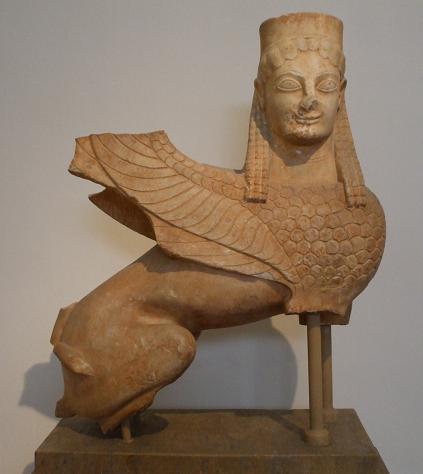
From looking at the vast numbers of grave stele in the museum I am confident to say that few, if not no, grave stele depicted any mythological event apart from as a crowning decoration. The grave stele are the only non mythological carvings that I came across during my study tour around Greece. Both of these examples from the museum have helped change my view on how much mythological events are portrayed through stone carvings. The grave stele showed me that while the Greeks did portray non mythological events on stone they did it only on grave stele suggesting that there must be a lot more mythological carvings.
Many sites depicted the same myths. One common myth that was carved into stone was that of Amazonachy. The Argive Heraion depicts this on its metopes while the temple of Asklepios at Epidaurus depicts is on its west pediment. There was also a fragment of a pediment found at Corinth which depicted a fallen Amazon warrior. The depiction of this myth was not limited to temples. I was surprised to find that it was also depicted on the scene building of the theatre at Corinth, a picture of one of the carvings is below.
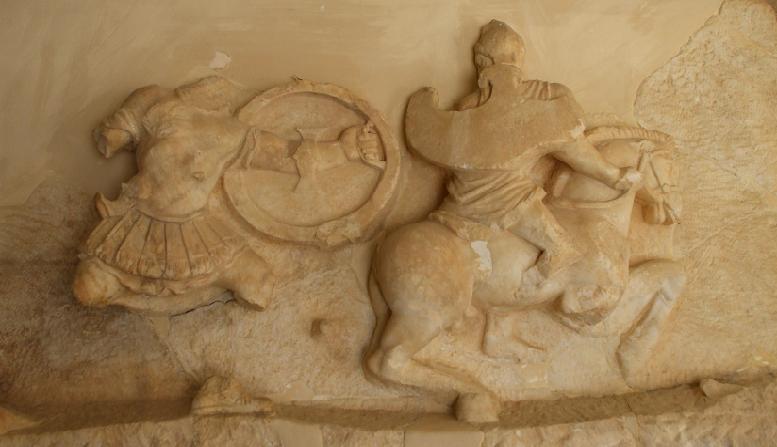
I did not know that the Greeks depicted myths, or anything, on parts of the theatre so the discovery of this really changed my perception of my question. It showed me that stone carvings appeared on a bigger range of architecture than I initially realised and the fact it was mythology told me that the use of mythology in stone carvings was vast. Another common myth was the trials of Herakles which appeared on temples and treasuries such as the temple of Zeus and the treasury of Massalia at Delphi.
From travelling around Greece on the study tour it is clear to see that my view on the quantity and type of architecture mythology appears on has changed. I always knew that mythology appeared on a lot of buildings but the different types of buildings, architecture and amount was more extensive than I originally thought. Even though I hoped to prove that mythology appears on a lot of architecture I did not realise quite how much there was and was therefore surprised at the huge quantity of mythological portrayal. There were far too many examples of places that had mythological carvings on them to mention with only a very small percent that I have included. It seems to me that the Greeks portrayed mythology as much as they could; with the only example I could find of non mythological portrayal being personal depiction on grave stele.
Navigation :
Pre Study Tour:
- Group Essay
- Bacchic Cults
- Visual Representation
- Local Patron Gods
- Representation of Women
- Role in Pan-Hellenism
After Study Tour:
- Group Essay
- Bacchic Cults
- Visual Representation
- Local Patron Gods
- Representation of Women
- Role in Pan-Hellenism
Admin: